
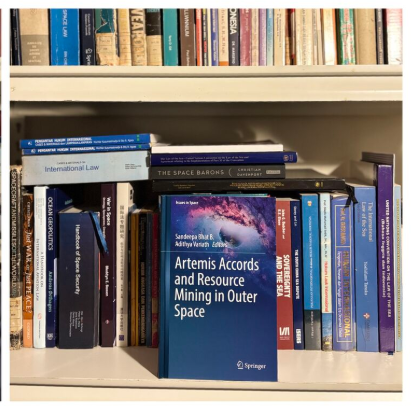
Surabaya, Indonesia — The Centre for Air and Space Policy (CASP) proudly announces the publication of a new academic chapter authored by CASP Director, Taufik R. Nugraha, in the newly released Springer volume Artemis Accords and Resource Mining in Outer Space. The book, edited by Sandeepa Bhat B. and Adhitya Variath, forms part of the Issues in Space series and brings together leading scholars to examine the legal and policy implications of humanity’s renewed ambitions in lunar and deep-space exploration.
Taufik R. Nugraha’s chapter, written in collaboration with Regi Rivaldi, appears as Chapter 8, titled “Deconfliction Measures in the Freedom of Use of Outer Space: What Lies Ahead?”. This chapter provides an in-depth analysis of one of the most debated aspects of the Artemis Accords: the deconfliction principle, including the establishment of safety zones and their impact on the long-standing principles of international space law.
A Significant Contribution to Contemporary Space Law
The chapter explores the evolving understanding of Articles I, II, and IX of the 1967 Outer Space Treaty (OST), particularly in the context of the rapid technological, commercial, and geopolitical transformation of outer space activities. Nugraha and Rivaldi examine how the deconfliction principle—originally rooted in military operational practices—has re-emerged within the Artemis Accords as a mechanism intended to prevent harmful interference among lunar operations.
Their analysis highlights several critical issues, including:
- The tension between safety zones and the non-appropriation principle, raising questions about potential “pseudo-sovereignty” over certain areas of the Moon or other celestial bodies.
- The possibility that deconfliction measures could inadvertently restrict freedom of access guaranteed to all states under Article I of the OST.
- The lack of a clear international authority—analogous to the International Seabed Authority—to monitor and regulate deconfliction zones, which may lead to legal ambiguity or even conflict.
- The expanding role of private actors in space resource activities and the implications for state responsibility under Articles VI and VII of the OST.
- The challenges of reconciling the Artemis Accords with existing customary international law, especially given differing interpretations by major spacefaring nations.
Positioning Indonesia in the Global Space Governance Discourse
Through this publication, Taufik R. Nugraha strengthens Indonesia’s voice in the rapidly intensifying global debate on the governance of outer space. As international actors push forward with lunar missions, in-situ resource utilization, and the establishment of long-term human presence beyond Earth, questions of territorial control, environmental protection, access equality, and the peaceful use of outer space have become increasingly urgent.
Nugraha’s work not only critically examines the legal gaps and risks posed by emerging practices but also offers constructive perspectives on how the international community might move forward, including through the creation of more robust regulatory bodies and clearer procedural mechanisms for consultation.
A Milestone for CASP
CASP celebrates this publication as a significant milestone in its mission to advance research and policy development in air and space law. The chapter reflects CASP’s commitment to producing rigorous scholarship that addresses contemporary global challenges and contributes to shaping the future of responsible and equitable space governance.
Artemis Accords and Resource Mining in Outer Space is now available through Springer and is expected to serve as a valuable reference for scholars, policymakers, and practitioners in international space law.